
On November 10, 2026, OpenAI opened a space to companies that looks a lot like the Google Business Profile they already manage: a brand can now claim its profile in ChatGPT, keep its information current and earn a blue check. The service is called Businesses in ChatGPT.
For a marketing leader, the news fits in one sentence: the profile makes your brand accurate in ChatGPT, it does not make it recommended. OpenAI says so itself, and that line frames the rest of this article.
What is Businesses in ChatGPT?
Three building blocks, gathered in a space called Business Hub.
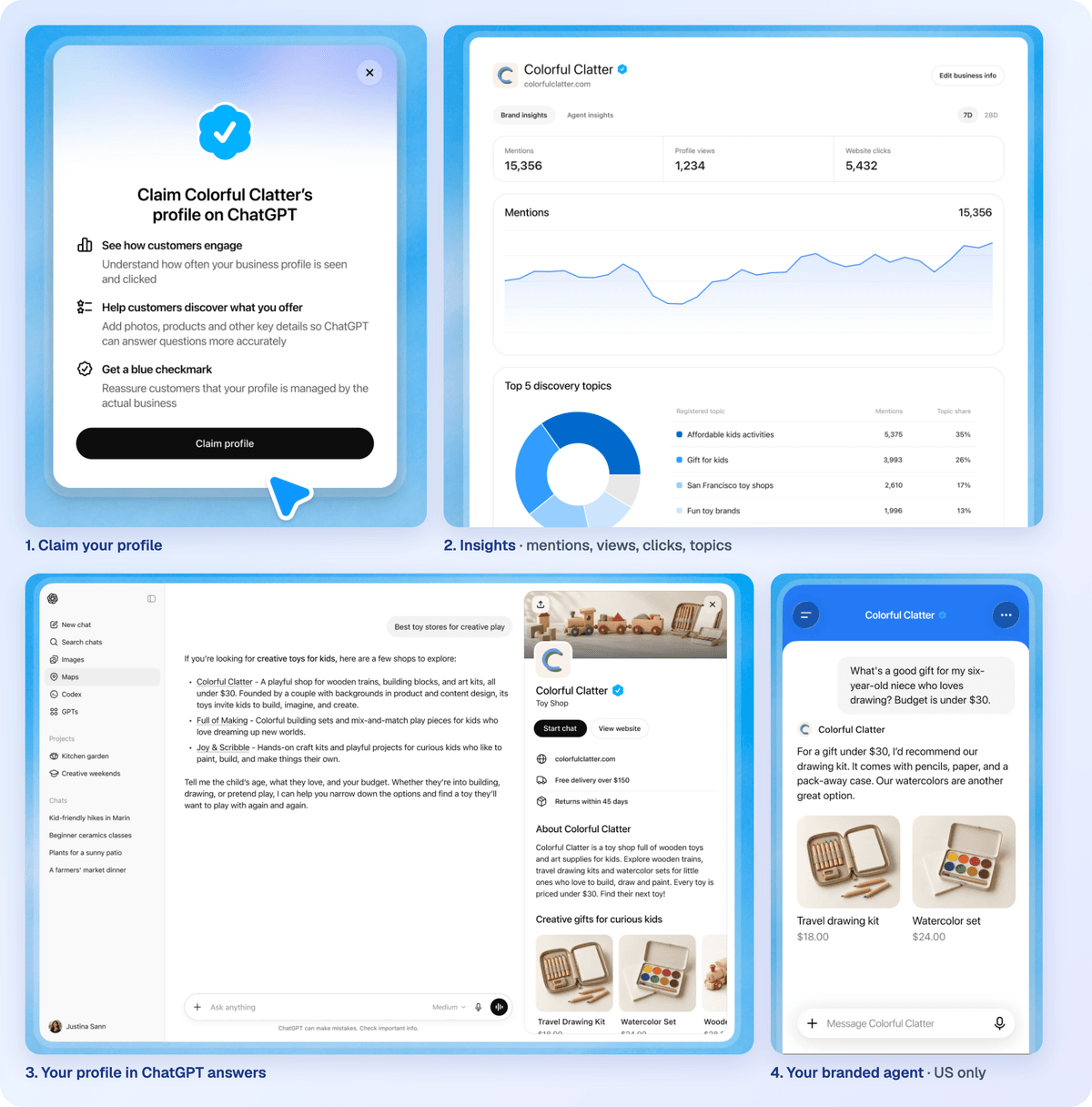
Businesses in ChatGPT in four screens. Claiming the profile, reading its insights, the profile shown next to an answer, and the branded agent, US only. The sample brand is OpenAI's. Screenshots: OpenAI.
| Block | What the brand can do | Availability |
|---|---|---|
| The profile | Claim it, correct description, logo, category, website and contact, earn a blue check. Retailers can upload a product feed with prices and availability. | Announced wherever ChatGPT is available, subject to eligibility |
| The Business Agent | Publish an agent that answers customer questions with the brand's own information and rules, connected to Shopify in three steps. | Ecommerce and online services in the US |
| The statistics | See mentions, profile views, clicks to the website and the top five conversation themes. | With the profile |
ChatGPT may use the profile's information to answer questions about the brand, according to OpenAI's official page. Several outlets, including The Next Web, also report that the agent can serve as the destination of ChatGPT ads.
Who can claim a profile, and where?
Any eligible business can start, for free, from a ChatGPT account, even a free one. Verification goes through a business phone or email, a DNS record or a Shopify store, then an identity check of the person representing the company. OpenAI's help center walks through the flow.
Outside the US, access may start with a waitlist. The Nanga team checked on November 11, 2026, from France, with two separate accounts, a services company and an ecommerce brand: both requests ended on the same "You're on the waitlist" screen. Service businesses are not open yet either, the option reads "coming soon".
Two practical consequences:
- The legal representative should file the claim. OpenAI may ask for company registration details. Teammates can be added afterwards, and an agency can be given access.
- One profile per brand, not per country. Claiming the main brand does not claim its locations, and nothing published so far provides one profile per market.
What the profile changes, and what it does not
The profile corrects. It gives ChatGPT an official version of the brand: what it sells, its website, its delivery and return terms, and for a retailer, its products, prices and stock. For a brand ChatGPT describes poorly, that is a real gain.
The profile does not get the brand recommended. OpenAI's page puts it plainly: "ChatGPT continues to make independent recommendations and comparisons. Claiming does not guarantee higher placement or sales."
In other words, OpenAI does not sell visibility inside answers. When someone asks "which online bank should I choose" or "which running shoe for a beginner", the brand named is still the one the model finds relevant from its sources: the brand's pages, comparisons, reviews, forums. That is GEO territory, and it has not moved.
What the OpenAI dashboard shows, and what it leaves out
For the first time, Business Hub gives a figure drawn from real conversations. That is its value, and it has limits.
| What Business Hub shows | What it leaves out |
|---|---|
| How often the brand is mentioned in ChatGPT | The prompts behind those mentions |
| Profile views and clicks to the website | Where the brand stands against competitors |
| The top five conversation themes | Gemini, Perplexity, Claude, Copilot or AI Overviews |
| A 7 or 28 day trend | Volumes below a minimum threshold, and the answers themselves |
A useful thermometer, on one engine. Google's free Search Console never replaced SEO platforms: it gave them a reference point. Business Hub will play the same role for AI visibility. Knowing how often ChatGPT mentions you does not say why, against whom, or what to fix.
How to prepare while the waitlist runs
Five steps, in this order:
- Sign the brand up on Business Hub at chatgpt.com/business-hub, from the legal representative's account, to take a place on the waitlist.
- Measure the starting point on ChatGPT: the brand's Recommendation Visibility on ChatGPT, against the other engines, before any profile exists. Without that baseline, no effect can be measured.
- Find the topics where ChatGPT ignores the brand. They are what the profile description should cover first, and the content to strengthen on the site.
- Prepare the information: description, category, terms, and for a retailer, a clean product feed or the Shopify connection.
- Date the profile's activation the day it goes live, to read a before and an after.
What Nanga adds
Since November 12, Nanga shows a "Your ChatGPT profile" card in every project's action plan. It sets the brand's starting point on ChatGPT against the average of the other engines (AI Visibility, Share of Voice, Source Share), the topics where ChatGPT mentions it least, and the steps to get ready.
The brand also records where its profile stands: not signed up, on the waitlist or live. The activation day lands on the performance curve, so the profile's effect can be read on ChatGPT and on the other engines, against competitors, prompt by prompt. Business Hub tells how often the brand is mentioned. Nanga tells why, against whom, and what to do next.